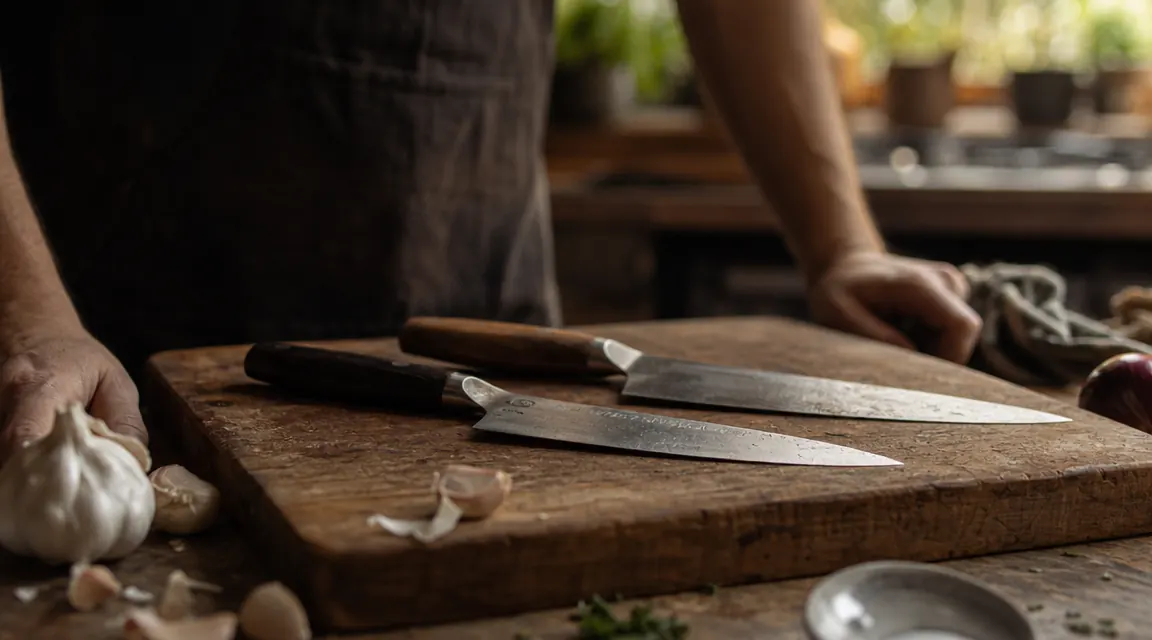
My neighbor Dana showed up at a block party last summer holding a Wusthof Gourmet she had just bought. She was proud of it. I had my Victorinox Fibrox Pro in my bag because I had agreed to do the slicing. We ended up using both knives side by side on a folding table while we broke down three watermelons and a flat of tomatoes. That informal test told me more about these two knives than any spec sheet. If you are standing in front of a browser tab right now trying to decide between the Fibrox and the Wusthof Gourmet, here is the short answer: the Victorinox wins for most home cooks, and the price gap does not buy you meaningfully better performance in a real kitchen.
That said, there are specific situations where spending more on the Wusthof Gourmet makes sense. I will walk through both sides honestly, because neither knife is a waste of money. They are just built for different buyers.
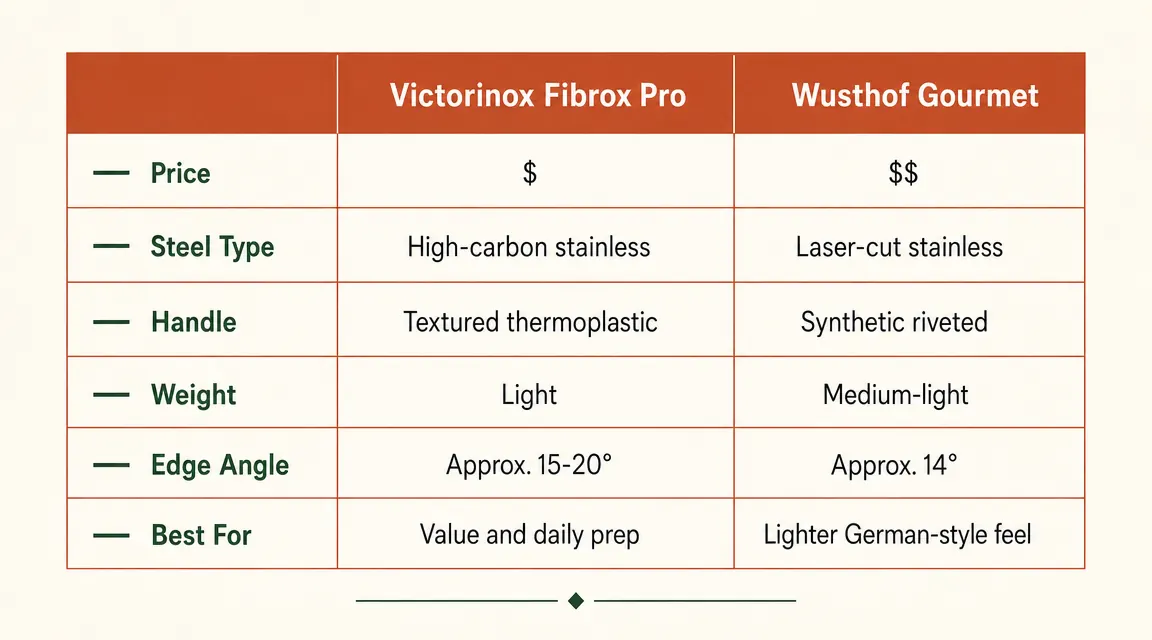
| Victorinox Fibrox Pro | Wusthof Gourmet | |
|---|---|---|
| Price (current) | Mid-range | Check today's price on Amazon |
| Blade Steel | Swiss high-carbon stainless (X50CrMoV15) | German high-carbon stainless (X50CrMoV15) |
| Edge Angle | 15 degrees per side | 14 degrees per side |
| Handle Material | Fibrox textured thermoplastic, grippy when wet | Polymer, smooth, slightly glossy |
| Blade Weight (8-inch) | Lighter, 5.8 oz | Slightly heavier, 6.3 oz |
| Balance Point | Blade-forward, fast through soft veg | More neutral, suits a pinch grip |
| Dishwasher Safe? | Yes (though hand-wash is better) | No (handle degrades) |
| Made In | Switzerland | Germany |
| Full Tang? | Yes | Yes |
| Warranty | Lifetime limited | Lifetime limited |
Where the Victorinox Fibrox Pro Wins
The handle is the first thing most people notice. The Fibrox Pro uses a textured thermoplastic grip that stays secure even when my hands are wet with chicken juice or tomato pulp. That matters on a school-night when I am rushing through dinner prep and my hands are not exactly dry. The Wusthof Gourmet handle is smooth polymer with a more traditional European bolster look, but when it gets slippery it gets slippery. I have fumbled it once reaching over a steam pot. I have never fumbled the Fibrox.
Out-of-the-box sharpness also goes to the Victorinox in most side-by-side tests. The 15-degree-per-side edge is thin enough for very fine work without being so delicate that it chips if you hit a butternut squash seam at a bad angle. I have used mine for everything from mincing ginger to halving a spaghetti squash, and it has never needed more than a few passes on a honing rod between sharpenings. It is also dramatically easier on the budget. At the mid-range price point, you are buying a knife that culinary schools issue to students precisely because it performs like a professional tool without requiring a professional budget to replace if it gets dropped.
The lighter weight also makes a difference during long prep sessions. I do a big Sunday meal prep most weeks: a full sheet pan of roasted vegetables, a whole chicken broken down, fruit sliced for school lunches. The Fibrox's slightly blade-forward weight means I am doing less work per cut. By the time I am washing up, my forearm does not feel it the way it does after a long session with a heavier knife.
Ready to cut your prep time without cutting your budget?
The Victorinox Fibrox Pro is the knife culinary schools trust, now available for home cooks at a price that leaves money for the groceries you are chopping.
Amazon Check Today's Price on Amazon →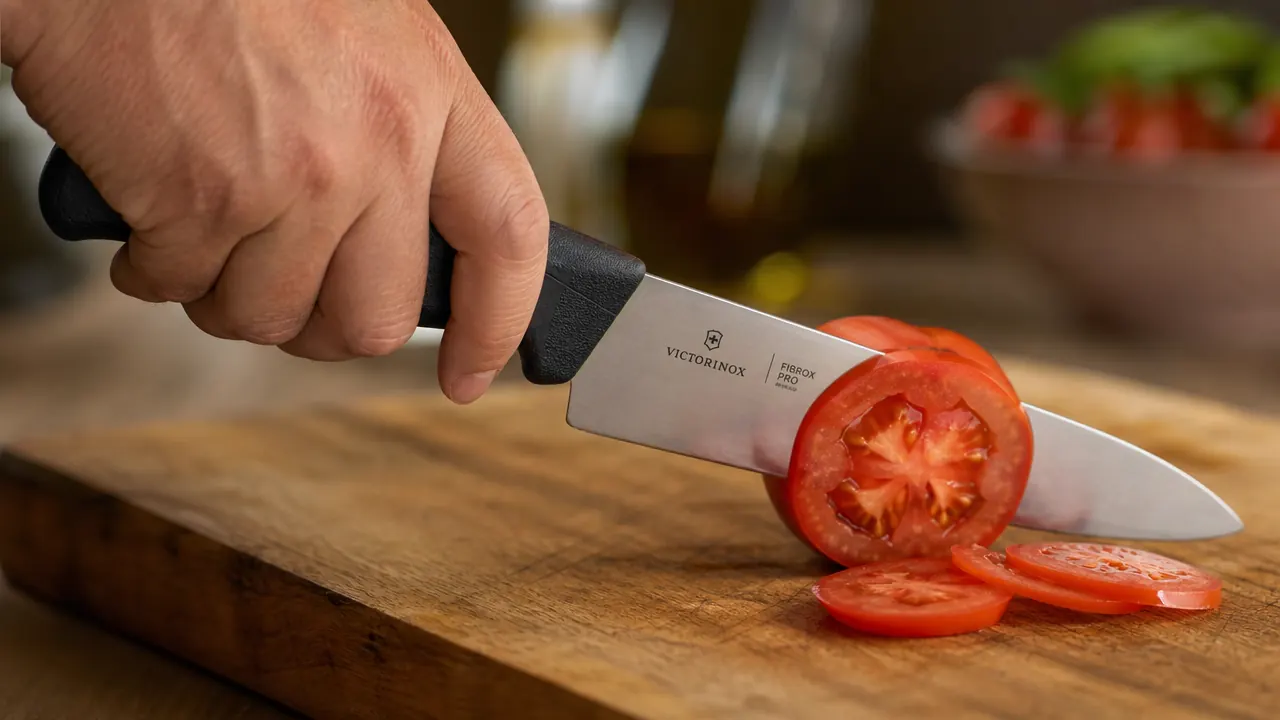
Where the Wusthof Gourmet Wins
The Wusthof Gourmet has real advantages for a specific type of cook. If you prefer a traditional European handle with a more neutral balance point and you always use a pinch grip, the Wusthof will feel more natural in your hand. The slightly heavier weight some people find reassuring. It feels more substantial, more like what their grandmother's good knife felt like, which is not a small thing. Kitchen tools carry a tactile memory, and for cooks who have always used heavier German-style knives, the Fibrox can feel almost too light.
The Wusthof Gourmet also looks better on a magnetic strip or in a knife block. This is not entirely vanity. If you have guests who will see your kitchen tools, the Wusthof reads as a serious knife in a way the Fibrox, with its workhorse rubber handle, does not. The Wusthof Gourmet is also widely available at kitchen specialty stores, which means if you need it quickly or want to feel the weight before buying, you can often find one in a physical shop. The Fibrox is sold primarily online.
Both knives share nearly identical steel. The price gap is not about metallurgy. It is about handle feel, aesthetics, and what kind of cook you picture yourself being.
Sharpness Over Time: What Actually Happens After a Year of Dinner Prep
Both knives use very similar high-carbon stainless steel. The composition is close enough that edge retention is roughly comparable over time with the same honing and sharpening habits. The real difference at the one-year mark tends to come down to how easy each knife is to maintain. The Fibrox's thinner edge does respond very quickly to a honing rod, which means you can keep it razor-sharp with about 30 seconds of work before each use. The Wusthof Gourmet is also easy to hone, but the slightly more neutral grind angle means some people do not notice it needs attention as quickly, and they let it go longer between tune-ups than they should.
If you are the kind of person who uses a honing rod consistently, both knives will stay sharp for years. If you are the kind of person who sharpens once a year when the knife noticeably struggles on a tomato, the Victorinox will probably forgive you a little faster because it is easier to bring back on a simple pull-through sharpener. Neither knife is indestructible, and neither should go in the dishwasher regularly regardless of what the label says.
Handle Comfort for Long Prep Sessions
I want to spend a moment on handle ergonomics because this is where I see the biggest split in preference. The Fibrox handle is bulkier in diameter. If you have smaller hands, that extra girth can cause fatigue. Several friends with smaller hands have picked up my Fibrox and immediately said it felt too wide. The Wusthof Gourmet handle is narrower with a more traditional bolster taper, which smaller-handed cooks often find easier to control on detailed work like deveining shrimp or segmenting citrus.
If you have average to large hands, the Fibrox handle is excellent. If you have smaller hands and do a lot of precision work, hold both before committing if you can. The Fibrox's grip is still better in wet conditions regardless of hand size, but comfort during fine work is worth weighing.
The Real Cost Calculation
Here is how I think about the price gap as someone who watches every dollar in the kitchen budget. The Victorinox Fibrox Pro runs at the lower end of current pricing. The Wusthof Gourmet runs at the higher end. That gap is substantial. For that difference, you get a slightly heavier knife, a narrower handle, and a look that photographs better. You do not get meaningfully sharper steel, better edge retention, or a more durable blade. Both carry a lifetime warranty. Both are made in countries with serious cutlery traditions.
Put another way: the Fibrox money left over could buy a quality honing rod, a decent pull-through sharpener, and a good cutting board. That combination will make any knife perform better over its life than a more expensive knife used on a poor surface with no maintenance. If you are new to knives, I would always rather see someone buy a great budget knife and invest in the accessories that support it than stretch to a premium knife and skip the honing rod.
Who Should Buy the Victorinox Fibrox Pro
Buy the Victorinox if: you are cooking weeknight dinners for a family and need a workhorse that can break down a whole chicken on Monday and slice sheet-pan vegetables on Thursday without drama. Buy it if you have average or large hands and appreciate a grippy handle that will not slip when you are rushing. Buy it if you are buying your first serious chef knife and want something that a culinary student would recognize as a legitimate professional tool. Buy it if you do not have a honing rod yet and need to leave room in the budget for one. Buy it if you do not particularly care what your knife looks like on the counter.
Who Should Consider the Wusthof Gourmet Instead
Consider the Wusthof Gourmet if: you have smaller hands and find wide-grip handles uncomfortable during long prep sessions. Consider it if you already own a honing rod and a sharpener, so the extra budget goes straight into the knife rather than accessories. Consider it if kitchen aesthetics matter to you and you want something that looks the part on a magnetic strip. Consider it if you have always used traditional European-style knives and the Fibrox's lighter, blade-forward feel simply does not match your established muscle memory. The Wusthof Gourmet is a very good knife. It is just not dramatically better than the Fibrox at twice the price.
The Fibrox costs half as much and cuts just as well. Here is current pricing.
Over 9,600 home cooks and professional kitchen workers rate the Victorinox Fibrox Pro 4.7 out of 5 stars. Check today's price and see if it is in stock.
Amazon Check Today's Price on Amazon →