

My mornings used to run on a kind of controlled chaos. I am up at 6:10, kids need to leave by 7:40, and somewhere in that 90-minute window I have to make my pour-over coffee, get breakfast on the table, pack lunches, and find whatever my son Ethan left on the bus the day before. For a long time I was boiling water on the stovetop, standing there watching a pot, then trying to remember if it had cooled down enough for my coffee grounds. It sounds like a small thing, but when you are already juggling four tasks before your first sip of caffeine, a finicky kettle adds real friction.
I bought the Cosori Electric Kettle with Temperature Control (1.7L, ASIN B08BFMV68M) eight months ago after my sister mentioned she used it for green tea. I was not looking for a coffee gadget per se; I just needed something faster and less watchful than a pot of water. What I got was something that genuinely changed the rhythm of my mornings, and not in a marketing-brochure way. In a real, repeatable, Tuesday-morning-with-a-missing-permission-slip kind of way.
The Quick Verdict
Fast, precise, and quiet enough that it does not wake the kids. The keep-warm function is the feature I did not know I needed. Minor gripe: the base cord is short.
Amazon Check Today's Price →Still pouring from a stovetop pot? Your coffee deserves better water temperature.
The Cosori 1.7L heats to any of six presets in under two minutes. Check today's price on Amazon before you boil another ruined cup.
Amazon Check Today's Price on Amazon →How I Have Used It Over Eight Months
My use case is pretty specific: pour-over coffee for me at 195 degrees Fahrenheit, and herbal or green tea for my daughter Mia at either 175 or 185 depending on what she picks. I fill the kettle once, hit the preset I need first, pour, then hit a different preset for the second drink. On busy mornings that second use happens while I am also packing lunches, so the keep-warm function has saved me more times than I can count.
I have also used it for instant oatmeal (212 degrees, the boil preset), for my mother-in-law's black tea when she visits (that woman is particular about temperature), and twice for heating water on camping-adjacent road trips where we stayed at a cabin without a full stove setup. The kettle travels well. I just wrap the cord around the base and it fits in a tote bag without complaint.
Over eight months I estimate I have run this kettle somewhere between 400 and 500 times. The interior stainless steel still looks clean. The backlit control panel works exactly as it did on day one. No scaling visible despite our moderately hard tap water, which I credit partly to descaling it once around the four-month mark using a white vinegar soak for 30 minutes.
The Six Temperature Presets: What They Actually Cover
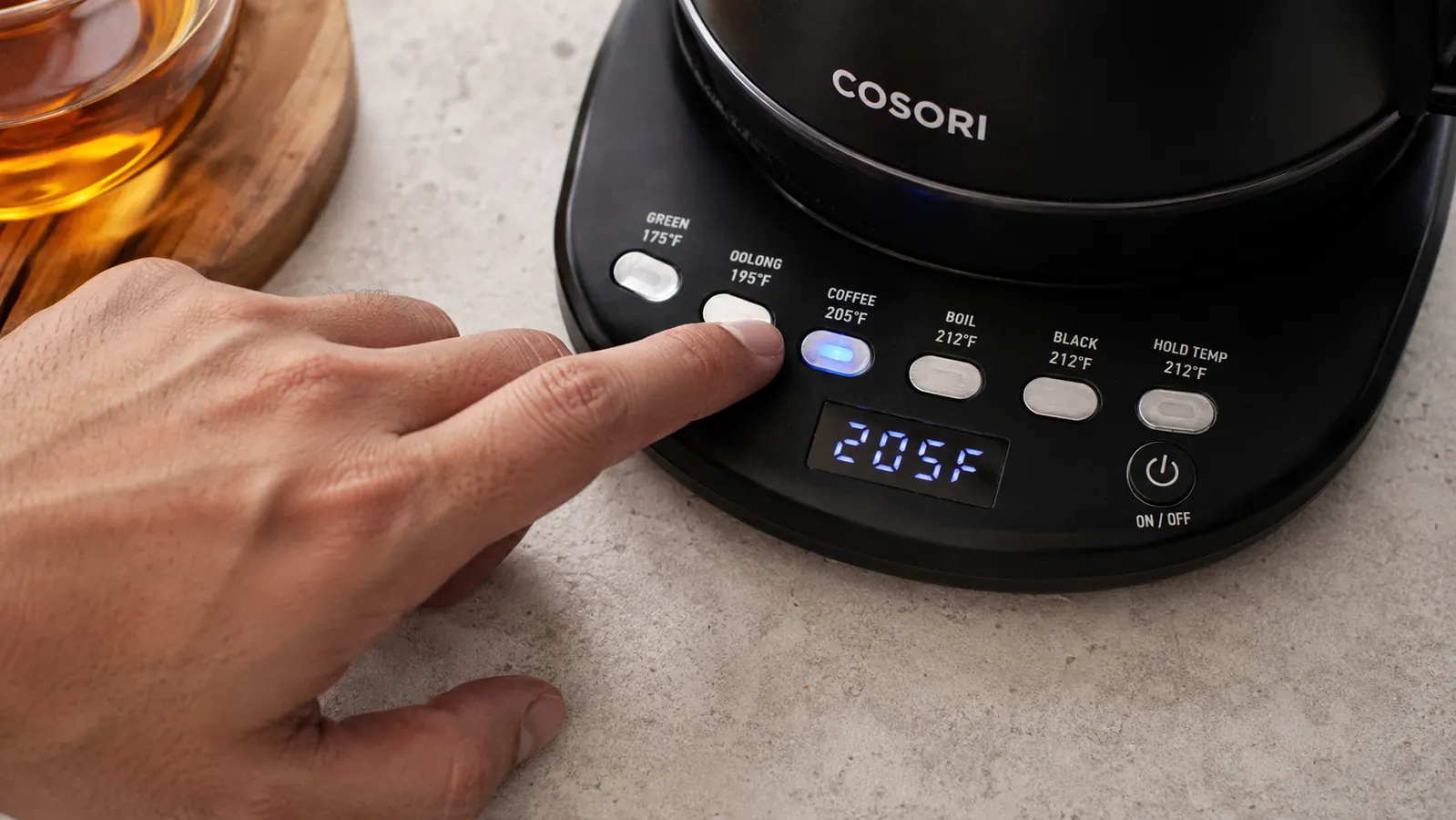
The six presets are 140 F, 160 F, 175 F, 185 F, 195 F, and 212 F (boil). Cosori labels them loosely on the base panel with drink icons, but you can also just watch the digital readout and stop it wherever you want. Here is how they map to real drinks in my kitchen. The 140 F preset is gentle enough for delicate white or floral teas that go bitter if you overshoot. My daughter and I discovered that when we tried a jasmine white tea and accidentally used 175 instead: it tasted vaguely like hot water that had given up. The 160 F preset is where green teas land best. The 175 F and 185 F range covers most herbal and oolong teas without extracting bitterness. The 195 F preset is my home for pour-over coffee. Coffee professionals argue over whether 195 or 205 is optimal; at 195 my Sumatra grounds taste clean and not scorched. The 212 F boil covers black tea, instant noodles, oatmeal, or anything you just need hot fast.
I verified the accuracy twice with a separate instant-read thermometer. At the 195 F preset the Cosori poured at between 193 and 197 degrees depending on how full the kettle was and how long it sat after the ready beep. That is within the margin where you would not taste a difference. At 175 F it read 174 to 177. Close enough for real-world morning use. If you are a competition-level barista doing dial-ins, you might want a gooseneck kettle with a proper PID controller. For the rest of us, this is more than adequate.
Heat Speed: Faster Than I Expected, With One Caveat
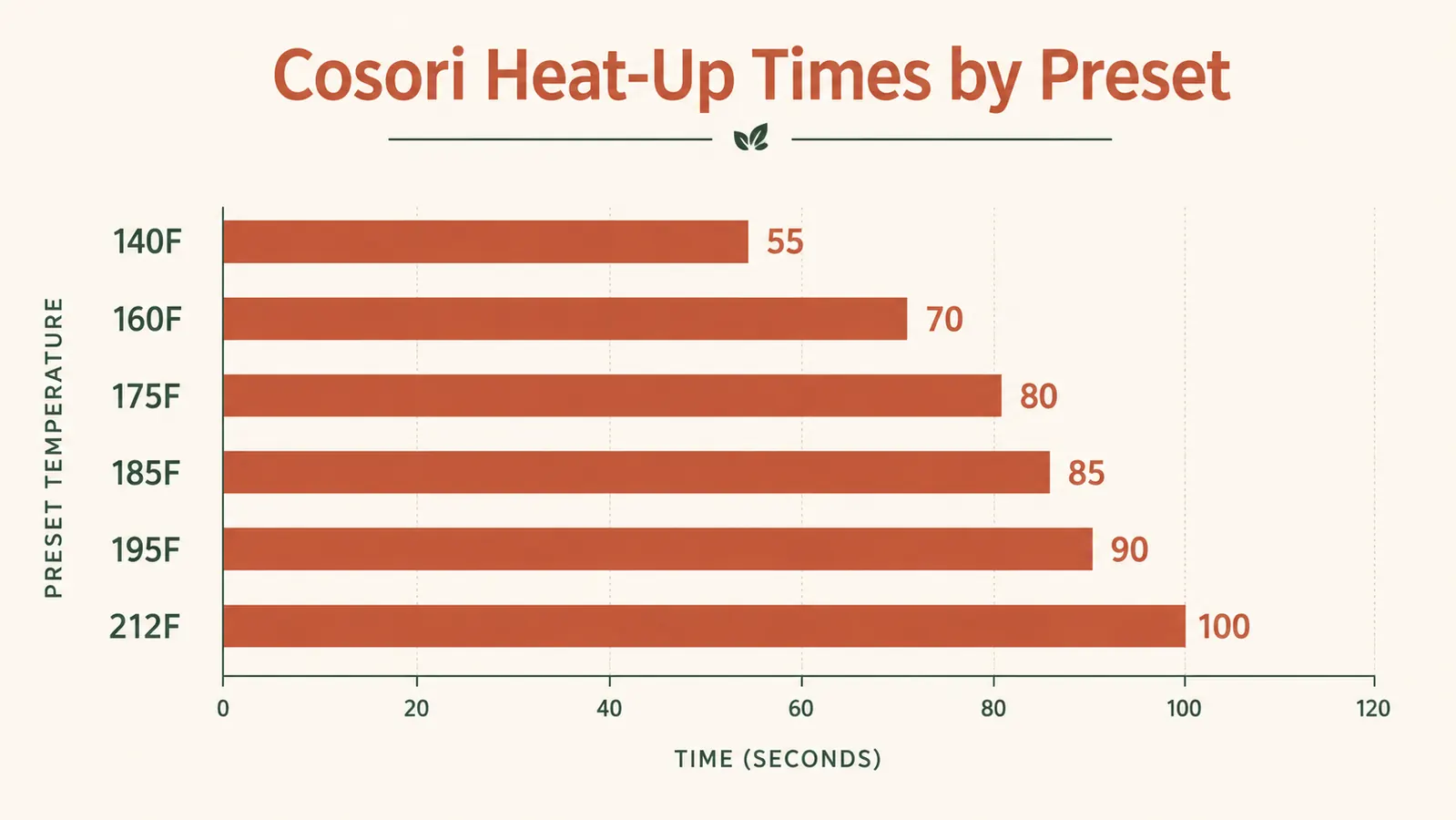
The kettle is rated at 1500 watts. For a full 1.7-liter load, a boil from room-temperature tap water takes about three and a half minutes on my kitchen counter with our 120V outlet. For my typical fill of about 600 to 700ml (enough for one pour-over plus one mug of tea), it reaches 195 F in roughly 90 to 100 seconds. That is genuinely fast. My old stovetop routine, including waiting for the burner to warm up, was five-plus minutes on a good day.
The caveat: the kettle is loud at full boil. Not alarming, but it has a rolling-boil turbine sound that my husband described as a small jet engine. At 195 F the noise is more moderate; it shuts off before a full rolling boil. I have learned to start it before I wake the kids, not after, so the sound does not cut through a quiet house at 6:15 a.m.
I have made more consistently good cups of coffee in the last eight months than I did in the five years before. Not because I learned new technique, but because the water temperature stopped being a guess.
Keep-Warm Feature: The Underrated Selling Point
The 60-minute keep-warm function holds whatever temperature you set for up to an hour after the kettle finishes heating. In practice it cycles the heating element on briefly every few minutes to maintain the preset. You activate it by holding the preset button after the initial heat cycle, or you can toggle it on as part of the initial selection. The difference is about six to eight degrees of drift in the first ten minutes if keep-warm is off versus virtually none if it is on.
This became essential for me because I often start the kettle while I am making lunches, and then forget about it for four minutes while I am arguing with Ethan about whether a cheese stick counts as a vegetable. By the time I come back to pour, if keep-warm is on, I still have 195 F water. Without it I would have water that has cooled to maybe 180 F, which is fine for tea but changes pour-over extraction noticeably. Small thing, big difference in practice.
What I Liked
- Six temperature presets cover every common hot drink without custom programming
- Heats 700ml to 195 F in under two minutes, faster than any stovetop method
- 60-minute keep-warm holds temperature accurately enough for real-use cooking and coffee
- Interior is food-grade stainless with no plastic contact where water sits
- Lid stays on during pours, no accidental drips or splashing
- Digital readout is clear and readable across the counter in low kitchen light
- Quiet enough at lower temperature presets for early-morning use
Where It Falls Short
- At full boil it is noticeably loud, not a gentle simmer noise
- Base cord is roughly 27 inches, which can be limiting depending on outlet placement
- Kettle has some exterior plastic on the handle and base; the interior is all stainless but handle-conscious buyers should note this
- The ready beep is three tones and cannot be silenced, which matters if your household is asleep when you brew
Build Quality After 400-Plus Uses
The exterior is brushed stainless steel on the body with a black handle and base. The handle has a rubberized grip insert that has not worn or peeled after eight months. The hinge on the lid opens smoothly; I have not noticed any loosening. The 360-degree swivel base is solid, no wobble. One thing I checked around the three-month mark: the seal where the handle meets the body of the kettle, because I had heard complaints from other reviews about a similar Cosori model developing a crack there over time. Mine shows no sign of that. I do not drop it or overfill it, which probably helps.
The window for checking water level is on the right side of the kettle body. It has min and max lines. Easy to read, does not fog up from steam. The max line corresponds to about 1.7 liters; I have never needed to fill it that full, but it is useful to know where the upper limit sits. Overfilling an electric kettle can cause sputtering during a boil, so the window helps prevent that.
How the Cosori Compares to a Basic Single-Temp Kettle
Before this, I briefly used a no-name kettle that had one setting: boil. If you wanted lower-temperature water, you boiled it and then waited, which is essentially the same problem as the stovetop pot but slightly faster. The Cosori costs more, but the variable temperature is not a luxury feature. If you make any drink other than black tea and boil-level herbal blends, you are actively ruining your drink by using boiling water. Green tea at 212 F is bitter and flat. Pour-over coffee at 212 F overextracts and tastes harsh. The temperature control is the feature, not a checkbox on the spec sheet.
If you only make one type of drink and it requires boiling water, a budget single-temp kettle is fine and you do not need this one. If you cycle between two or more drink types at different temperatures, the Cosori pays back its premium in the first week by eliminating the guess-and-wait approach.
For a deeper comparison between the Cosori and a gooseneck-style option, see our Cosori vs Bonavita Gooseneck comparison. And if you are still weighing whether an electric kettle is worth the counter space at all, the 10 reasons an electric kettle beats a stovetop pot breaks down the case in plain terms.
Who This Is For
The Cosori 1.7L is a strong fit if you make pour-over, AeroPress, or French press coffee and you have been frustrated that your results vary from cup to cup. Water temperature is one of the biggest variables in coffee extraction, and controlling it precisely with a button press removes that variable entirely. It is equally strong for tea drinkers who switch between types, green one morning and black the next. If you have kids who drink herbal tea, the lower presets protect against burning delicate blends and also let you serve them a cup that is not scalding hot.
I would also recommend it for anyone whose mornings are timed tightly. The keep-warm function buys you a buffer. Start the kettle, get distracted by school-morning chaos for five minutes, come back, and still have water at the right temperature. That alone justifies the price difference over a basic kettle for a household like mine.
Who Should Skip It
If you exclusively make black tea or instant coffee and you just need boiling water, a much cheaper single-setting kettle does the same job. The Cosori's value is in the preset flexibility; if you will only ever use the boil setting, you are paying for a feature you will ignore. Additionally, if you are a serious pour-over purist who wants a gooseneck spout for controlled bloom pours, the standard spout on the Cosori does the job but it is not a precision gooseneck. For slow-pour techniques where a narrow stream matters, the Bonavita gooseneck is a better tool. And if counter space is genuinely tight, the 1.7L size is not small. It requires a dedicated spot. If you are space-constrained, that is worth factoring in before you buy.
Eight months in, I would buy it again without hesitation.
The Cosori 1.7L has outlasted two of my kids' fads and survived being unplugged and replugged every morning without a hiccup. Check today's price on Amazon and see if it fits your morning routine.
Amazon Check Today's Price on Amazon →